On the morning of September 5, 2026, in Hanoi, the Academy of Public Administration and Governance solemnly organized the Opening Ceremony for the 2026–2027 academic year. The Academy's English Web Portal respectfully presents the English translation of the full text of the speech delivered by Assoc. Prof. Dr. Nguyen Ba Chien, Secretary of the Party Committee and President of the Academy of Public Administration and Governance, at the ceremony.
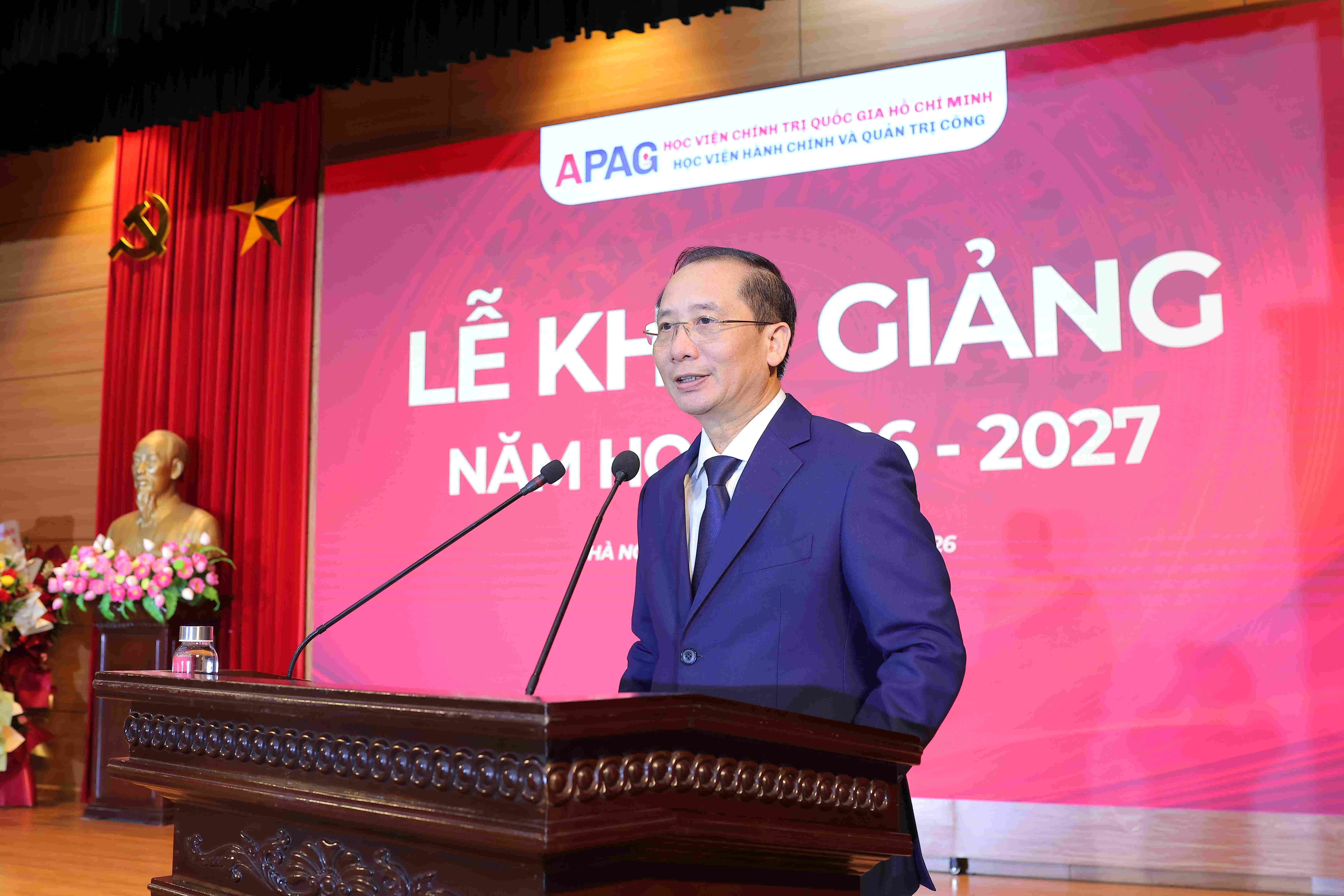 Assoc. Prof. Dr. Nguyen Ba Chien, Secretary of the Party Committee and President of the Academy of Public Administration and Governance, delivers the opening address for the 2026–2027 academic year
Respected Assoc. Prof. Dr. Nguyen Duy Bac, Vice President of the Ho Chi Minh National Academy of Politics,
Distinguished delegates and guests,
Dear faculty members, officers, staff, and all students!
Today, amid the joyful and enthusiastic atmosphere of the nationwide opening day for the new school year, the Academy of Public Administration and Governance solemnly holds the Opening Ceremony for the 2026–2027 academic year. This marks the beginning of a new academic year filled with new goals, motivations, expectations, and determination. For the Academy of Public Administration and Governance, today's opening ceremony also embarks over 4,000 newly admitted students of 2026 on a new journey of learning, self-cultivation, and personal growth.
On behalf of the Party Committee and the Board of Directors of the Academy, I extend my warmest greetings and wishes for good health, happiness, and success to Assoc. Prof. Dr. Nguyen Duy Bac - Vice President of the Ho Chi Minh National Academy of Politics, distinguished delegates, faculty members, officers, staff, and all students.
Distinguished delegates!
Dear teachers and all students!
The 2026–2027 academic year begins amidst rapid transformation. The nation is entering a new stage of development, where science, technology, and artificial intelligence are profoundly reshaping methods of learning, research, working, and societal development governance, placing increasingly high demands on human resource quality. These shifts pose a clear mandate for higher education: to not only impart knowledge, but to build and develop competencies; to not only equip learners with specialized expertise, but to prepare them with adaptability, critical thinking, innovation, and value creation in a constantly changing world.
For the Academy of Public Administration and Governance, this is both an imperative and a mission. In this new era, we must continue to innovate to train high-quality human resources who are not only solidly grounded in their specialties, but also possess development governance thinking, practical problem-solving capabilities, technological mastery, an innovative spirit, and a sense of responsibility and dedication to serving the community, society, and country.
I believe that the measure of an academic year is not merely the tasks completed, but more importantly, the extent to which educational quality has been elevated and how much each student has grown.
Dear freshmen!
During the first-of-term orientation session, I had the opportunity to discuss with you your university journey in the new era. Today, I want to reiterate an idea I consider especially crucial: you are enrolling in 2026 and will graduate in 2030—a milestone of special significance as the nation celebrates the 100th anniversary of the founding of the Party and enters a new development phase with higher expectations regarding knowledge, competence, work efficiency, and youthful responsibility. The next four years are not merely a timeframe to complete a curriculum. They are four years for you to prepare yourselves for a rapidly evolving and advancing future.
What the Academy desires is not just for you to receive a university diploma after four years of study. More importantly, it is for you to develop your personal capabilities to work effectively, cultivate the fortitude to make choices, build the capacity to adapt, and foster the responsibility to create value.
Knowledge is the foundation, but knowledge only gains true meaning when transformed into competence.
Competence is essential, but competence holds real value only when guided by character, responsibility, and tangible value creation.
Therefore, learn to understand more deeply, think more independently, solve more complex problems, and become increasingly clear about what you can contribute to society. Do not settle for merely completing a study program. Ask yourselves after every semester: What new knowledge have I gained? What more have I accomplished? In what ways have I matured? If you can answer those questions earnestly, you will not let your university years pass by in vain.
Each student comes to the Academy from a different starting point and will eventually choose a distinct career and life path. The Academy cannot decide your future for you. What the Academy can and must do is create a conducive environment for you to study, conduct research, experience, challenge yourselves, and grow—giving every student the opportunity to maximize their potential.
Respected faculty members!
In an era where knowledge can be accessed rapidly, a teacher can no longer be a mere transmitter of information. The more vital role of an educator is to orient perception, develop critical thinking, unlock inquiries, uphold academic standards, and help students cultivate self-study, self-research, and self-development capabilities.
A valuable lecture does not necessarily tell students everything, but rather inspires them to explore further, equips them with the ability to ask questions, and teaches them how to seek answers independently. I hope our faculty members will continue to boldly innovate teaching methodologies; strengthen the link between theory and practice; integrate research, discussion, critique, and problem-solving into the learning process; and build a learning environment where lecturers and students co-create knowledge and pursue new values. Educational innovation must ultimately manifest in every class hour, every lecture, and in the genuine progress of our students.
In the 2026–2027 academic year, the Academy will continue to place training quality and student competency development at the center. Academic programs must become increasingly modern, flexible, and tied to practical demands. Testing and evaluation must focus more heavily on practical application and problem-solving abilities. Scientific research must become an essential modality of higher education, enabling students to learn how to identify issues, gather evidence, form independent thinking, and build problem-solving capacities.
Digital transformation and artificial intelligence must be effectively integrated into teaching, learning, research, and governance. A modern educational institution is defined not only by advanced technology, but primarily by modern mindsets and individuals who master technology in service of developmental creation.
On this occasion, on behalf of the Party Committee and the Board of Directors of the Academy, I express my sincere gratitude for the timely and effective leadership and guidance of the Party Committee and Board of Directors of the Ho Chi Minh National Academy of Politics, as well as the attention, guidance, and cooperation of relevant agencies and units regarding training operations and the construction and development of the Academy of Public Administration and Governance. This serves as both encouragement and a vital foundation for the Academy to continue innovating, enhancing educational quality, and fulfilling its responsibilities to learners and society.
Once again, I wish Assoc. Prof. Dr. Nguyen Duy Bac - Vice President of the Ho Chi Minh National Academy of Politics, along with distinguished guests, faculty members, officers, and staff, good health, happiness, and success.
I wish all students a new academic year full of energy, creativity, and outstanding achievements in learning, research, and self-cultivation!
Thank you very much!