On the morning of September 3, 2026, at the 371 Nguyen Hoang Ton campus, the Academy of Public Administration and Governance organized the Opening Ceremony of the First-of-Term Orientation Week for the 2026–2027 academic year, designated for full-time undergraduate students admitted in 2026. This significant event helps new students familiarize themselves with the higher education environment, gain a deeper understanding of the Academy, and establish their mindset, goals, and learning methods for the four-year journey ahead
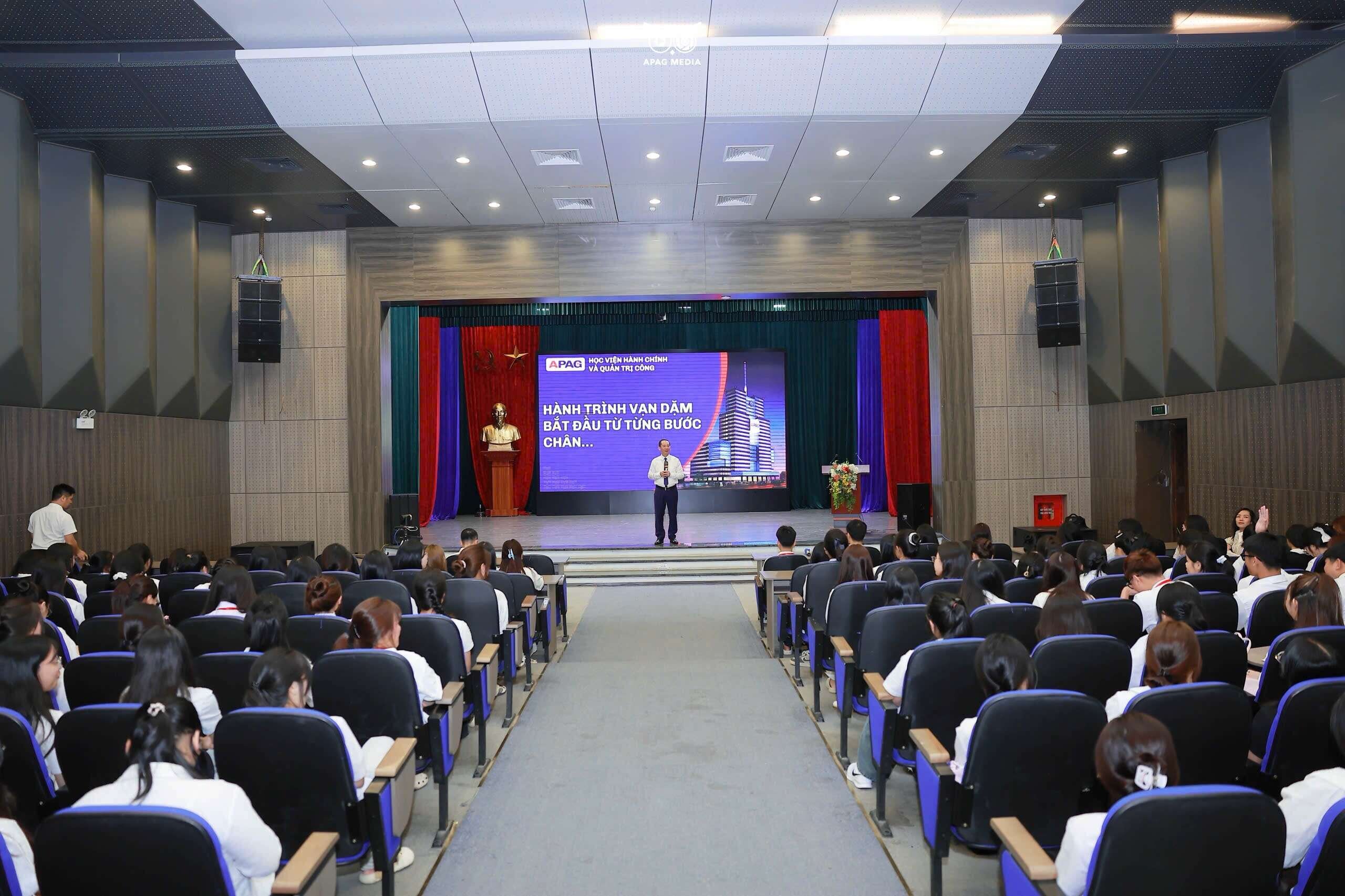 Overview of the program
Starting the University journey with proactivity and responsibility
Attending and directly delivering the opening thematic session titled "Traditions, Mission, Vision, Core values, and Educational philosophy of APAG; Mindset, Tasks, and Requirements for APAG Students in the New Era" was Assoc. Prof. Dr. Nguyen Ba Chien, President of the Academy of Public Administration and Governance. The program was held in person at the 2nd Floor Hall, 371 Nguyen Hoang Ton campus, and broadcast online to the 5th Floor Hall, 36 Xuan La campus, as well as regional branches. Over 1,000 new students joined online via Microsoft Teams, alongside students attending in person across various venues, creating a vibrant, unified, and far-reaching atmosphere throughout the Academy.
In his opening remarks, Assoc. Prof. Dr. Nguyen Ba Chien congratulated the new students on officially becoming members of the Academy. The President emphasized that the First-of-Term Orientation Week is a vital activity opening the academic year, providing students with foundational information about the Academy, training programs, academic regulations, and student affairs, while helping learners cultivate a sense of responsibility and proactively prepare essential competencies for their academic and personal development.
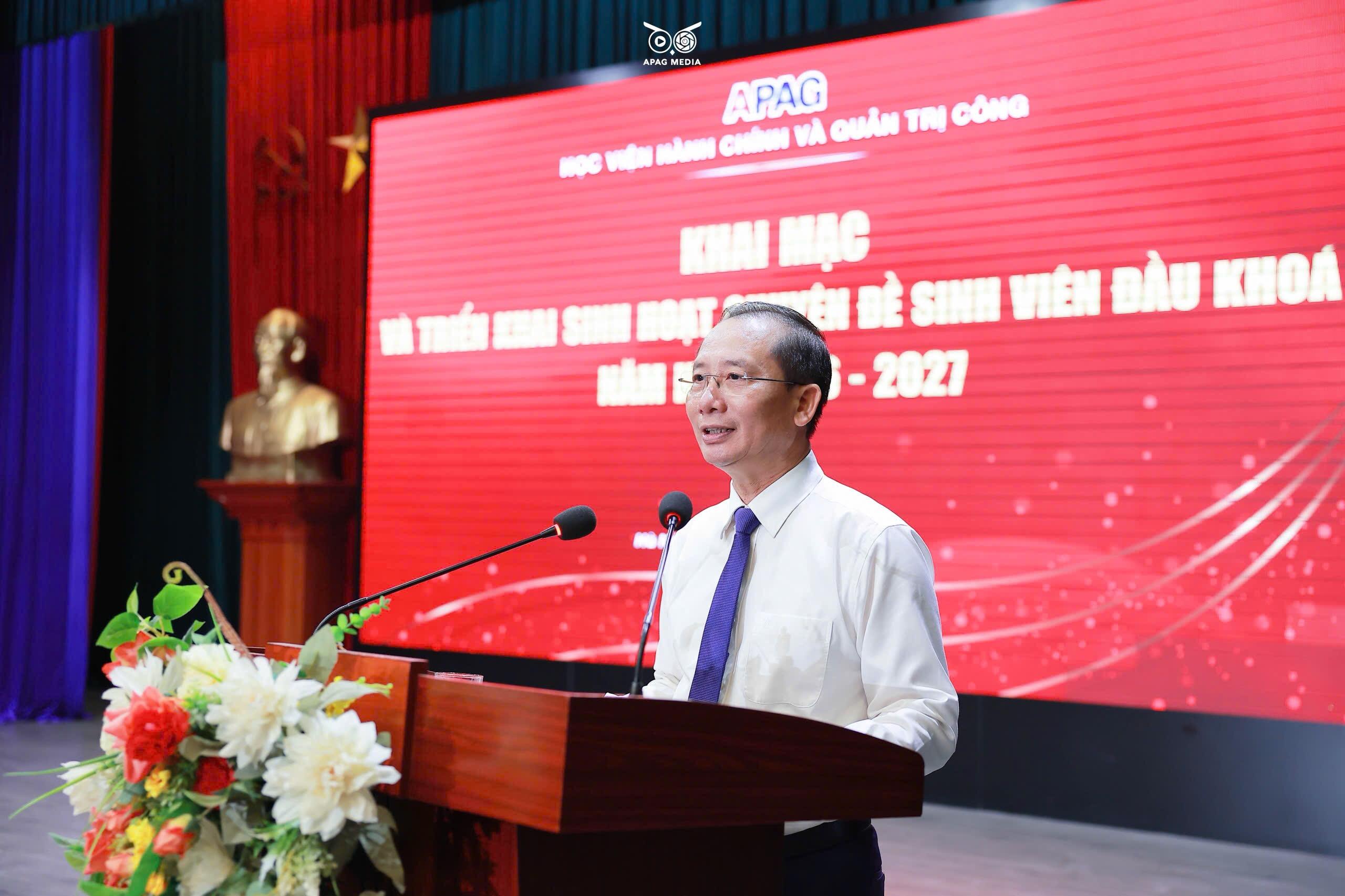 Assoc. Prof. Dr. Nguyen Ba Chien, President of the Academy of Public Administration and Governance, shares insights at the program
Three questions to begin a Four-Year journey
In the session "APAG Students in the New Era," Assoc. Prof. Dr. Nguyen Ba Chien guided new students around three core questions: "Where am I studying? Who will I become? What must I do starting today?". These are not merely questions for the first day of entering lecture halls, but issues every student should regularly reflect on throughout their academic path.
Addressing the question "Where am I studying?", new students gained deeper exposure to the traditions, identity, mission, and core values of which they are now a part. Established and developed since 1959, the Academy of Public Administration and Governance is entering a new development phase, aspiring to become a key national higher education institution by 2030 and achieve international standards in university governance by 2045. The Academy's heritage is thus not only a source of pride, but also places upon today's generation of students the responsibility to build upon and write new chapters.
University is not an extension of high school
Faced with rapid advancements in science, technology, AI, data, innovation, and international integration, Assoc. Prof. Dr. Nguyen Ba Chien underscored the need for students to transform their learning methods. University is not simply a process of absorbing knowledge or studying for exams; it requires shifting toward learning to understand, developing critical thinking, solving problems, and pursuing lifelong learning.
The four years at the Academy should be viewed as a process of self-creation. Beyond technical expertise, students must step by step develop independent thinking, digital and AI capabilities, research skills, foreign language proficiency, integration readiness, communication, collaboration, and leadership skills, along with self-directed learning and adaptability. Accordingly, a graduate's value is measured not merely by a diploma, but by practical competencies that can be applied in work and life.
Mastering AI without letting AI replace critical thinking
A key point highlighted in the presentation was the requirement to use AI responsibly in learning and research. AI can serve as a powerful tool for searching, synthesizing, analyzing, and developing ideas, but it cannot replace independent thinking, verification, judgment, creativity, and individual responsibility.
Alongside competencies, APAG students must build a strong moral foundation rooted in honesty, discipline, responsibility, integrity, respect, and a spirit of service. These elements form the enduring value of learners and serve as the foundation for students to excel further in the future.
Expectations for a generation of capable and ambitious APAG students
Guided by these orientations, Assoc. Prof. Dr. Nguyen Ba Chien conveyed his expectations for the Class of 2026: to become students who know how to learn, think, act, and create value. During their four years at the Academy, every student must proactively define who they want to become, what area they wish to excel in, what societal issues they aim to contribute to, and what tangible outputs can demonstrate their competence.
The ultimate goal is not merely completing the curriculum, but leaving the Academy possessing genuine expertise in a field, true mastery of digital/AI tools, a proud research output, and meaningful contributions made to the community. This is precisely how today's generation continues the tradition and helps realize the Academy's growth aspirations in the new era.
Four years begin today. The future also begins today. The Academy will build the environment and platform and stand alongside learners; but each student ultimately decides how they mature, what value they create, and how far they go. Concurrently, faculty members should reference and spread the Academy's messages and orientations to students, accompanying the Board of Directors in organizing, supporting, and guiding learners, ensuring every K26 student experiences a proactive, responsible, and ambition-filled university journey.
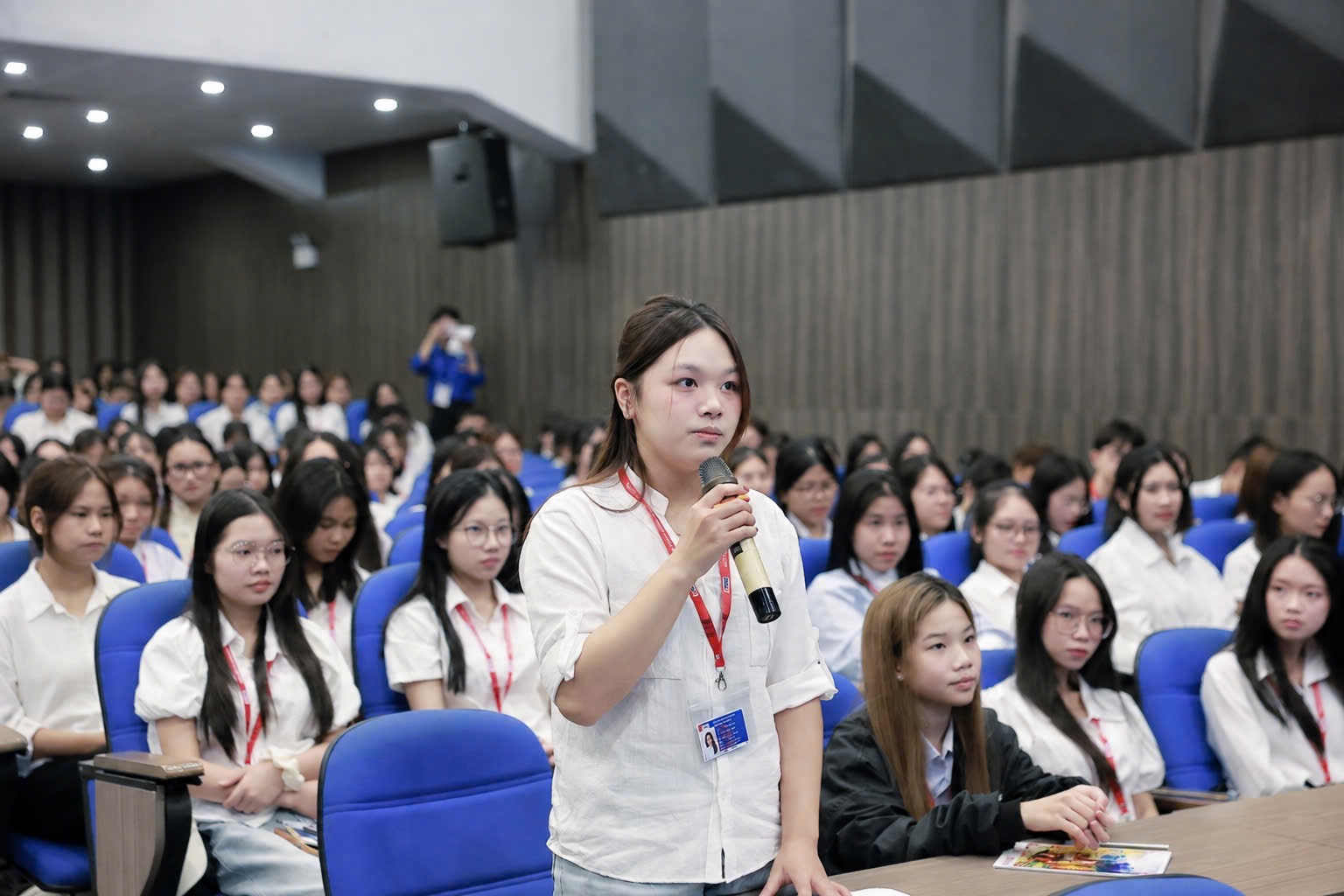
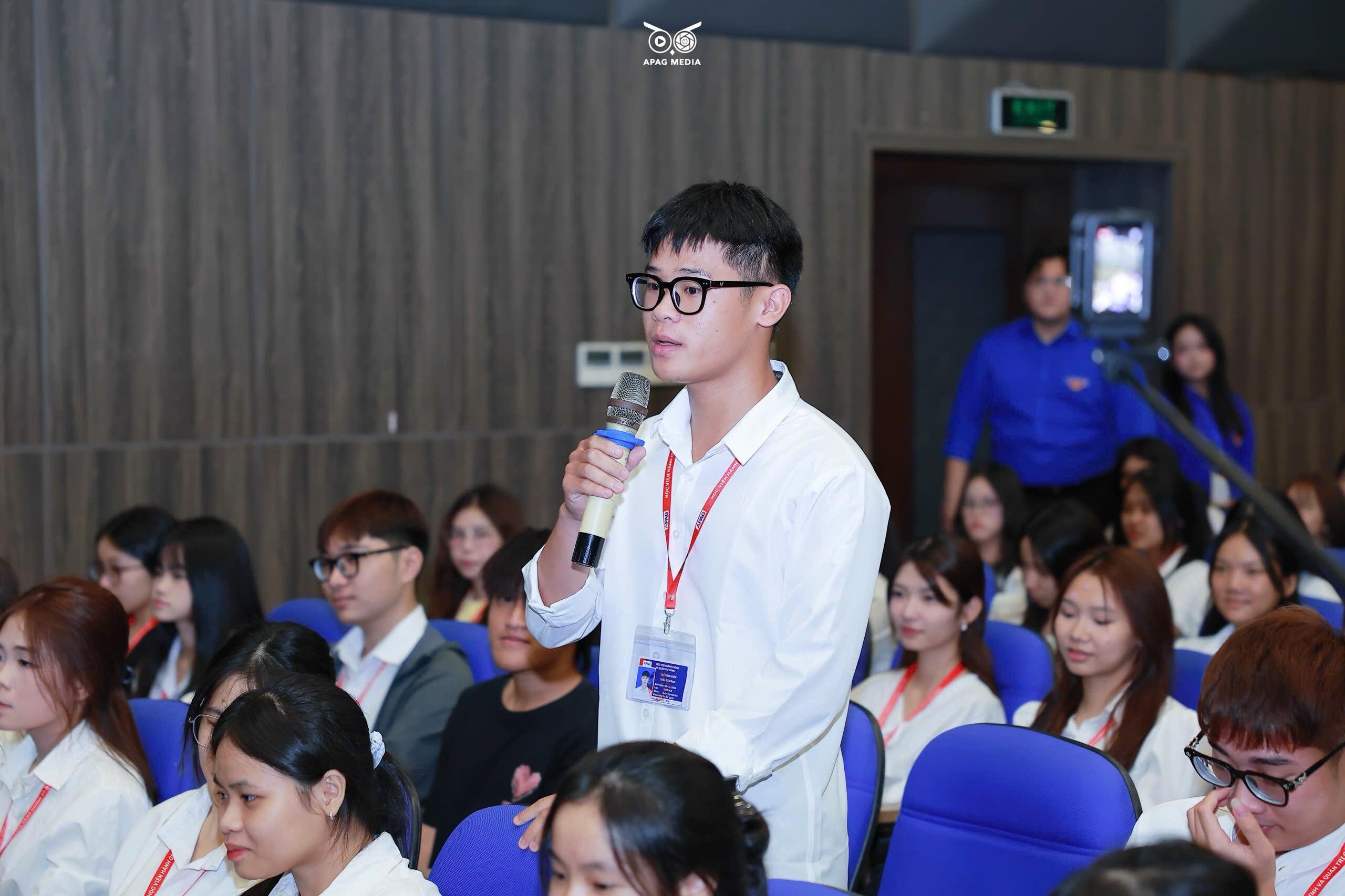 Students sharing their thoughts during the program
Building a solid mindset for the First days of University
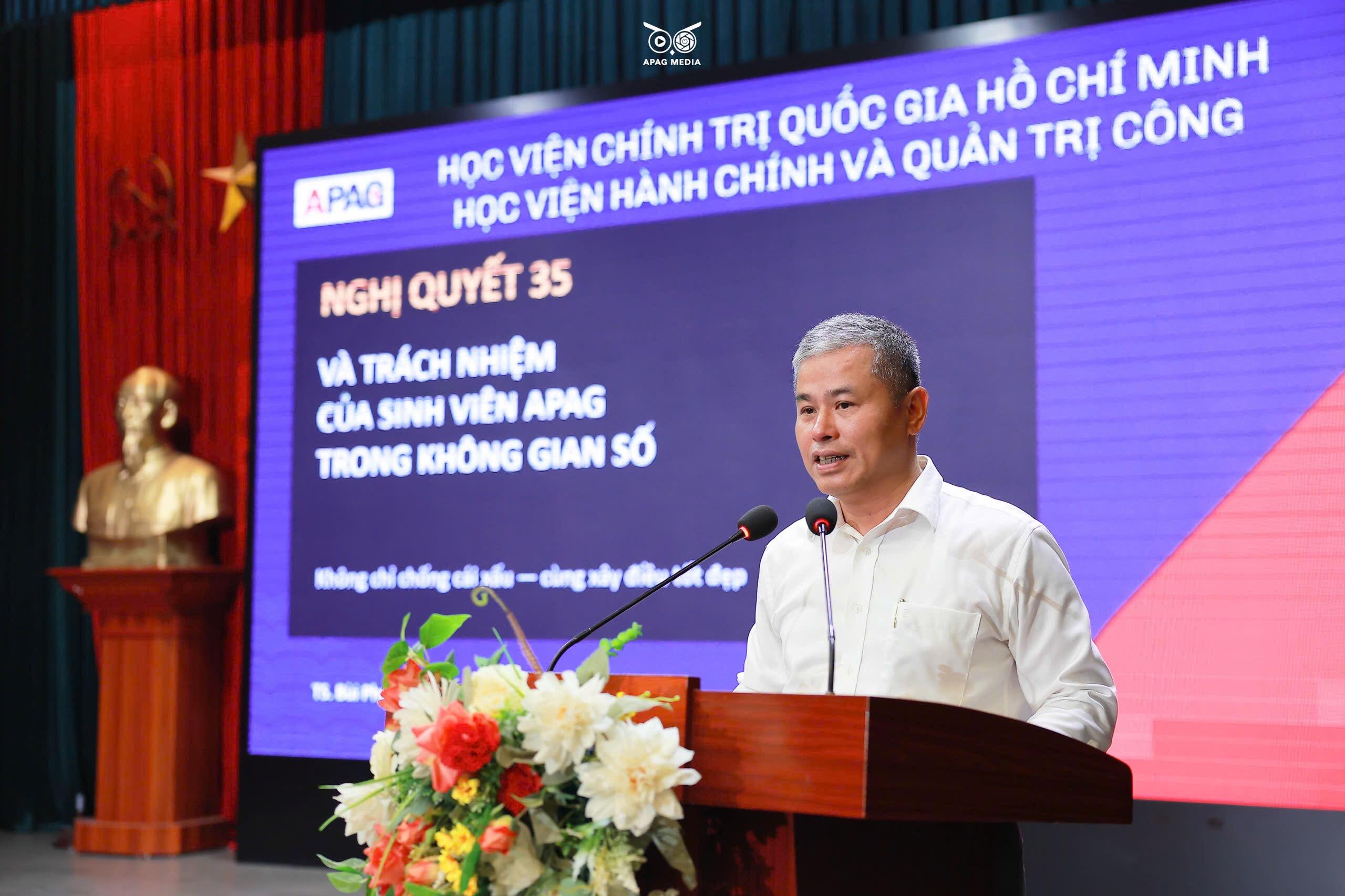 Dr. Bui Phuong Dinh, Vice President of the Academy, shares insights at the program
Dr. Bui Phuong Dinh, Vice President of the Academy of Public Administration and Governance, presented Topic 2: "The 67-Year Tradition of Construction and Development of the Academy; Politburo Resolution No. 35-NQ/TW dated October 22, 2018, on Strengthening the Protection of the Party’s Ideological Foundation and Countering Wrongful and Hostile Views in the New Situation – The Responsibility of Youth Union Members and Students of the Academy of Public Administration and Governance."
Following the sessions, many new students expressed excitement, actively engaging and asking questions to the lecturers. The insights and guidance from the very first session helped them better understand their chosen institution, providing renewed motivation and direction for their studies and personal growth in the coming years.
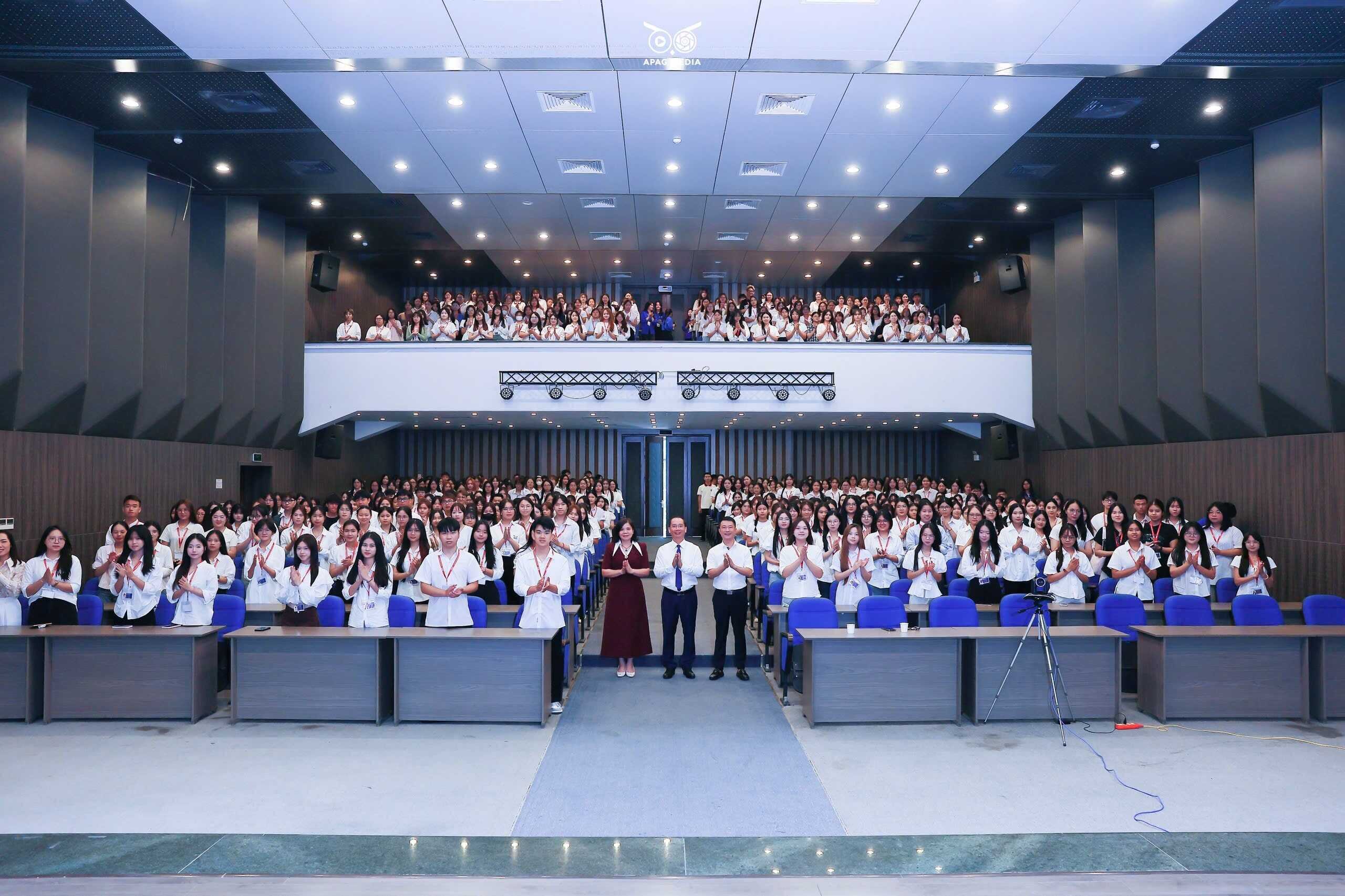 Assoc. Prof. Dr. Nguyen Ba Chien, President of the Academy, poses for a commemorative photo with the Class of 2026
The First-of-Term Orientation Week for the 2026–2027 academic year will continue with sessions on academic regulations, student affairs, study skills, research, practical experiences, and extracurricular activities. Through this, the Academy step-by-step equips new students with essential knowledge, skills, and mindsets to integrate into the university environment, proactively develop themselves, and strive to become knowledgeable, capable, resilient, and responsible citizens.