Shaping an agile governance method will act as a powerful catalyst for institutional reform, providing the necessary push to adapt to a rapidly changing landscape. This aims to mobilize resources and create a driving force for innovation and creativity across the entire system, leading the country toward fast and sustainable development
Assoc. Prof. Dr. Nguyen Ba Chien, President of the Academy of Public Administration and Governance, made this assertion during an interview with the Voices of Vietnam (VOV) E-magazine regarding the "Agile Government" model.
Reporter: Could you provide a general overview of the Agile Government model and its various levels of flexibility?
Assoc. Prof. Dr. Nguyen Ba Chien: The Agile Government model can be understood as a state governance framework that prioritizes speed and adaptability in a volatile context. It achieves this by making decisions and providing services centered around user needs (citizens and businesses). It operates on a cycle of testing, iterating, and continuous improvement based on real-time data, with an organizational design focused on networks and decentralization, ensuring transparency, accountability, and public value.
Government agility is not an "on or off" state; rather, it is manifested across different governance levels, from micro to macro:
·Operational Agility: This is the most basic level, reflected in the capacity to manage socio-economic affairs amidst fluctuations and the ability to improve and streamline public service delivery processes.
·Structural Agility: Reflected in the ability to quickly restructure the apparatus, establishing or dissolving organizations to solve emerging issues without being hindered by existing organizational structures.
·Strategic Agility: This is the highest and most challenging level, demonstrating a nation's capacity to forecast major trends, identify opportunities and risks, and proactively adjust its national vision, strategy, and development model (e.g., the decision to transition the growth model).
Reporter: In the practical context of Vietnam, how has the Agile Government model been manifested during the 2021-2025 period?
Assoc. Prof. Dr. Nguyen Ba Chien: Several government decisions and actions in recent times have demonstrated all three levels of agility: operational, structural, and strategic.
First, operational agility in macroeconomic management. In a context where the world faces an "inflation storm," geopolitical instability, and strategic competition between major powers, the Government and the State Bank have shown high proactivity and flexibility in coordinating fiscal and monetary policy tools. Concrete evidence is that Vietnam's inflation has been successfully controlled while GDP growth remains high compared to the region. Most recently, in early 2026, facing the impact of military conflicts in the Middle East leading to soaring oil prices, Vietnam adjusted "flexibly, smartly, alertly, and creatively" in managing fuel prices while simultaneously controlling inflation and promoting economic growth.
Second, structural agility in apparatus and personnel reform: This clearly demonstrates the political determination of the Party and State to streamline the apparatus and improve the quality of cadres and civil servants within the political system.
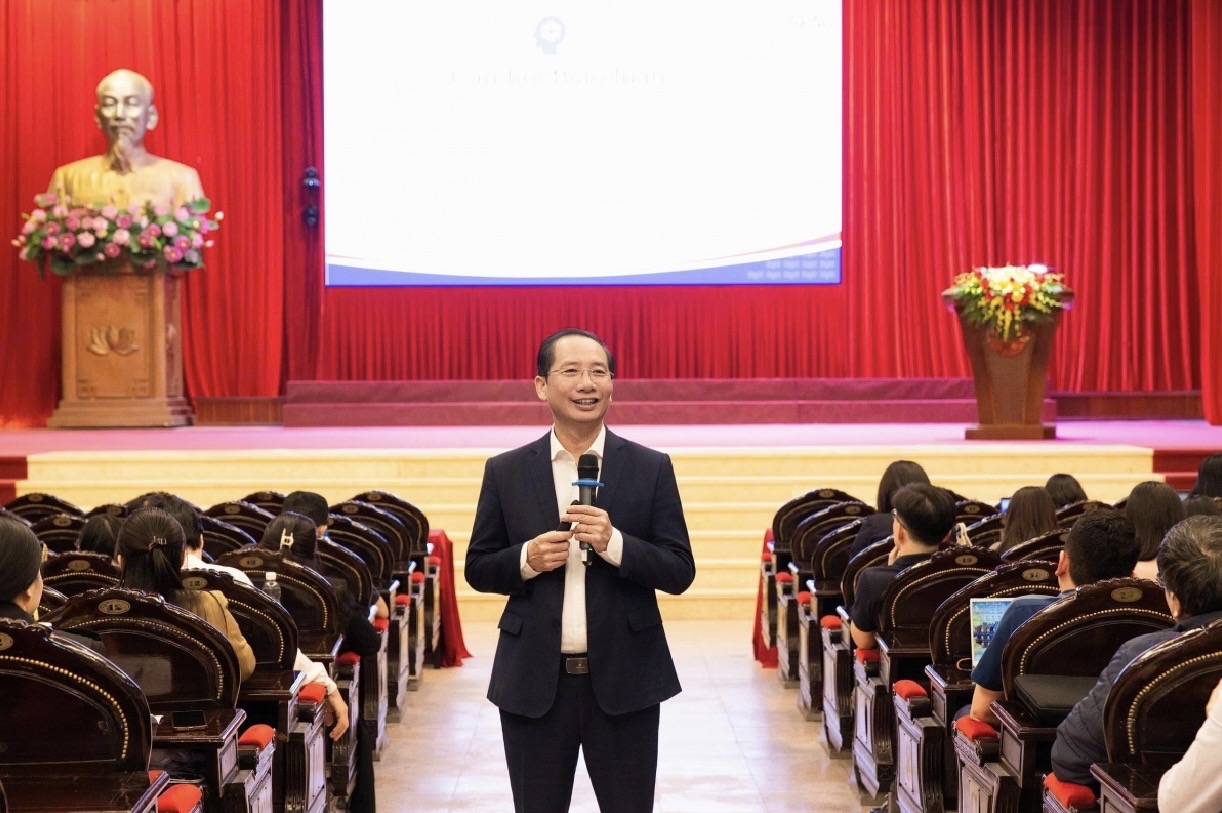 Assoc. Prof. Dr. Nguyen Ba Chien believes that several government decisions and actions in recent times have demonstrated all three levels of agility: operational, structural, and strategic.
Regarding the apparatus, Vietnam is conducting a revolution to create a lean, strong, efficient, and effective organizational structure. In 2025, the entire political system underwent a comprehensive and profound transformation, with a highlight being the transition from a three-tier local government to a two-tier local government. Prior to this, there were pilots for urban government models in several localities and the rearrangement of commune-level administrative units. This decisiveness shows a commitment to a more flexible and compact restructuring.
Regarding personnel: The mobilization, rotation, and consolidation of strategic-level personnel during the 2021-2025 term occurred with high frequency. This reflects adaptability and political determination in personnel arrangement with the motto "up or down," "in or out," to meet new task requirements and resolutely handle violations.
Third, strategic agility in crisis response. The landmark decision to shift the strategy from "Zero Covid" to "Safe, flexible adaptation and effective control of the epidemic" (Resolution 128/NQ-CP dated October 11, 2021) is a typical example. Facing changes in virus variants and unbearable socio-economic costs, the system dared to change a fundamental orientation, accepting risks to open the economy and avoid large-scale disruption.
At the end of 2024 and the beginning of 2025, the Politburo's issuance of the the four landmark resolutions: Nos. 57, 59, 66, and 68 created a unified entity of strategic thinking and action for national development in the new era. This is also an example of Vietnam's rapid state-transition capacity at the strategic level to adapt to new contexts.
In summary, during the 2021-2025 period, Vietnam proved its high flexible executive capacity. The Government report assessed: "That success reflects the Government's flexible executive capacity, the companionship of businesses, and the trust of the people."
In 2025, the entire political system underwent a comprehensive and profound transformation, with a highlight being the transition from a three-tier local government to a two-tier local government.
Reporter: Could you offer policy recommendations to shape national governance institutions according to the "Agile Government" model?
Assoc. Prof. Dr. Nguyen Ba Chien: For Vietnam to successfully achieve its 100-year strategic goals, shaping a national governance system operating under the "Agile Government" model is essential. Here are five key policy recommendations for implementing agile governance:
Recommendation 1: A revolution in thinking, institutionalizing the "right to experiment". Perfecting institutions to encourage and protect cadres who dare to innovate, create, think, decide, act, and experiment with new things for the common good; accepting controlled risks and learning from failure.
·Specific Action: Based on reviewing and evaluating the implementation of regulations on protecting cadres, work toward building a national law on institutional experimentation to create a safe legal space. This would allow piloting new economic models: digital economy, green economy, sharing economy... as well as emerging practical issues. This is the key to breaking the "fear of mistakes" mindset and the "fear of responsibility" disease, shifting from "doing the process correctly" to "doing things better" and creating more public value.
Recommendation 2: Building "Fast-Adapting Institutions". Developing the legal system in a lean, modern direction that is capable of adapting quickly and flexibly to practical fluctuations, especially urgent issues and new technologies.
·Specific Action: Research "dynamic legislation" mechanisms for emergency situations (epidemics, natural disasters, economic crises...), allowing the rapid issuance, amendment, and supplementation of legal documents through simplified procedures for the common good and national interest. Simultaneously, a "revolution" must be conducted to review and cut unnecessary processes and procedures, granting substantive power associated with transparency and the accountability of decision-makers.
Recommendation 3: Breaking "Siloed Governance" with substantive "Inter-sectoral Coordination Mechanisms". Innovating inter-sectoral coordination in a substantive and effective manner to solve strategic, complex, cross-sectoral, and regional linkage issues between localities.
Recommendation 4: Forming a synchronized and connected digital infrastructure and national data platform. Data must become a national strategic resource.
·Specific Action: Complete digital infrastructure in the direction of integration and connection, ensuring the capacity to store, process, and analyze large-scale data; develop shared platforms and integrated data-sharing platforms between ministries, sectors, and localities. Build a synchronized and connected national database system ensuring it is "correct, sufficient, clean, up-to-date, unified, and shared," linked with a unified electronic identity. Use Artificial Intelligence (AI) to analyze, forecast, and provide scenarios for leaders to make policy decisions.
Recommendation 5: Civil service reform and building an elite cadre contingent. Accelerate civil service reform, shifting recruitment, evaluation, and remuneration models from being based on seniority and degrees to being based on actual capacity and work efficiency, especially digital capacity, systemic thinking, and complex problem-solving skills.
·Specific Action: Establish superior remuneration regimes and protection mechanisms to attract, encourage, and retain talent with innovative, creative mindsets and a spirit of commitment to the development of the locality, the nation, and the people.
The core of building an agile government is a revolution in institutional thinking, shifting from a mindset of control to one of creation and support. It is a revolution in organizational and leadership culture, shifting from directing to empowering and accepting controlled risks for the common good.
Reporter: Thank you, Assoc. Prof. Dr. Nguyen Ba Chien