On 10 November 2026, at APAG Headquarters in Ha Noi, Assoc. Prof. Dr. Nguyen Ba Chien, President of the Academy of Public Administration and Governance (APAG), hosted a meeting with a delegation from Timor-Leste led by H.E. João Pereira, Ambassador Extraordinary and Plenipotentiary of the Democratic Republic of Timor-Leste to Viet Nam. The two sides exchanged views on administrative reform, organizational restructuring, the two-tier local government system, and the implementation of ASEAN commitments.
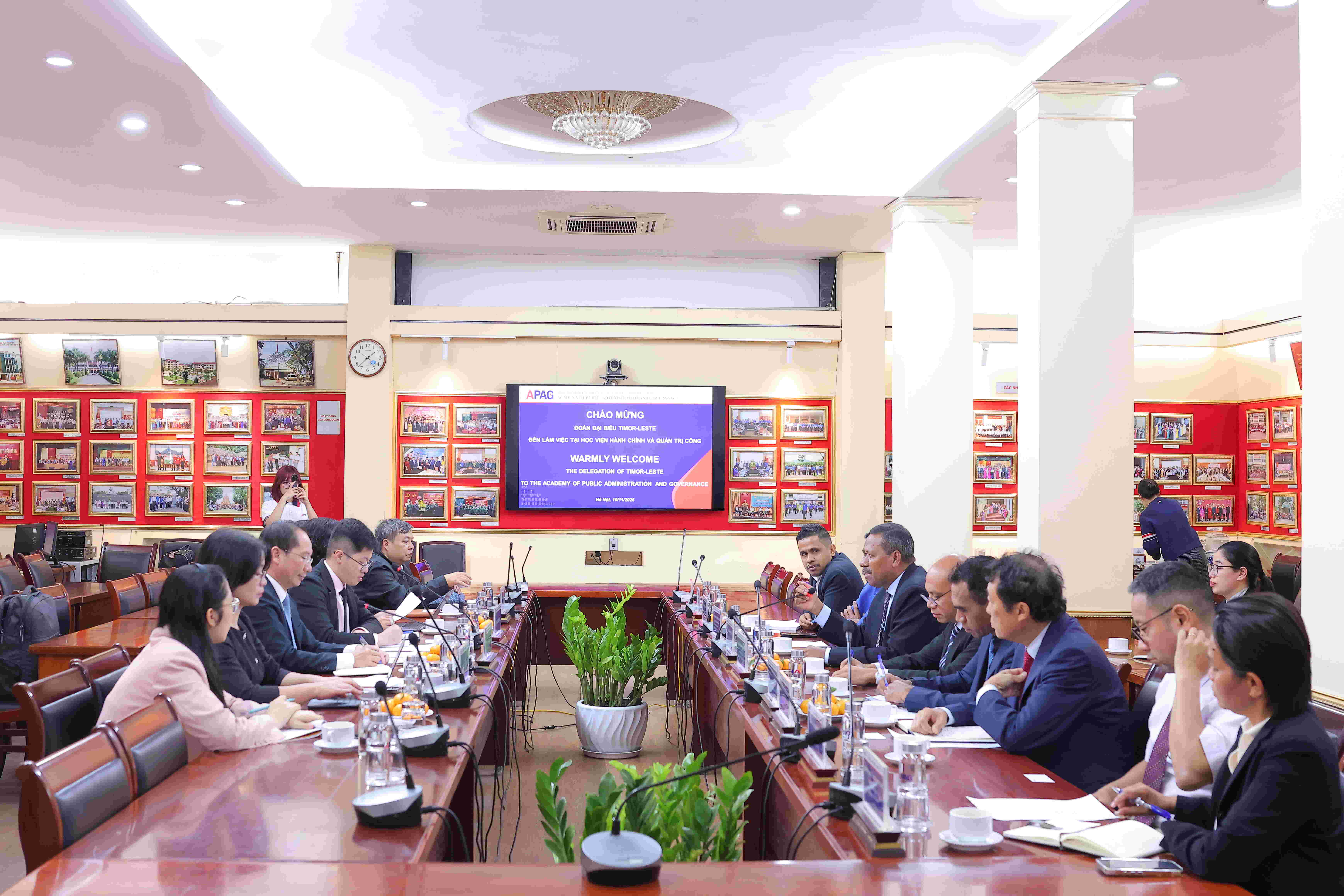 Overview of the meeting.
Attending the meeting, the Timor-Leste delegation included H.E. João Pereira, Ambassador Extraordinary and Plenipotentiary; Mr. António Augusto Guterres, Director General for Decentralization and Local Government, Ministry of State Administration; Mr. Xisto Domingos Freitas, Chief of Cooperation Department, Ministry of State Administration; Mr. ONO Yuji, Chief Advisor of the JICA-MNEC Office; Mr. Natsuki Shimegi, Project Coordinator of the JICA-MNEC Office; Ms. Rideca Regina Carvalho Duarte, Programme Officer of the JICA-MNEC Office; and Mr. Gil Cleofas da Silva, ASEAN Liaison Officer, Ministry of Foreign Affairs and Cooperation; Mr. Jorge Da Silva Cruz Araujo, Second Secretary of the Embassy of Timor-Leste in Viet Nam; Ms. Celina Mendonça, Technical Administrative; Ms. Vu Thi Linh, Secretary to the Ambassador.
Representing APAG were Assoc. Prof. Dr. Nguyen Ba Chien, President of APAG; Assoc. Prof. Dr. Dang Khac Anh, Dean of the Faculty of Social Development Management; Dr. Bui Thi Thanh Thuy, Deputy Director of the Department of Science Management and International Cooperation; Dr. Bui Thi Ngoc Hien, Vice Dean of the Faculty of Administrative Sciences; Dr. Phung Van Hien, Vice Dean of the Faculty of Economics.
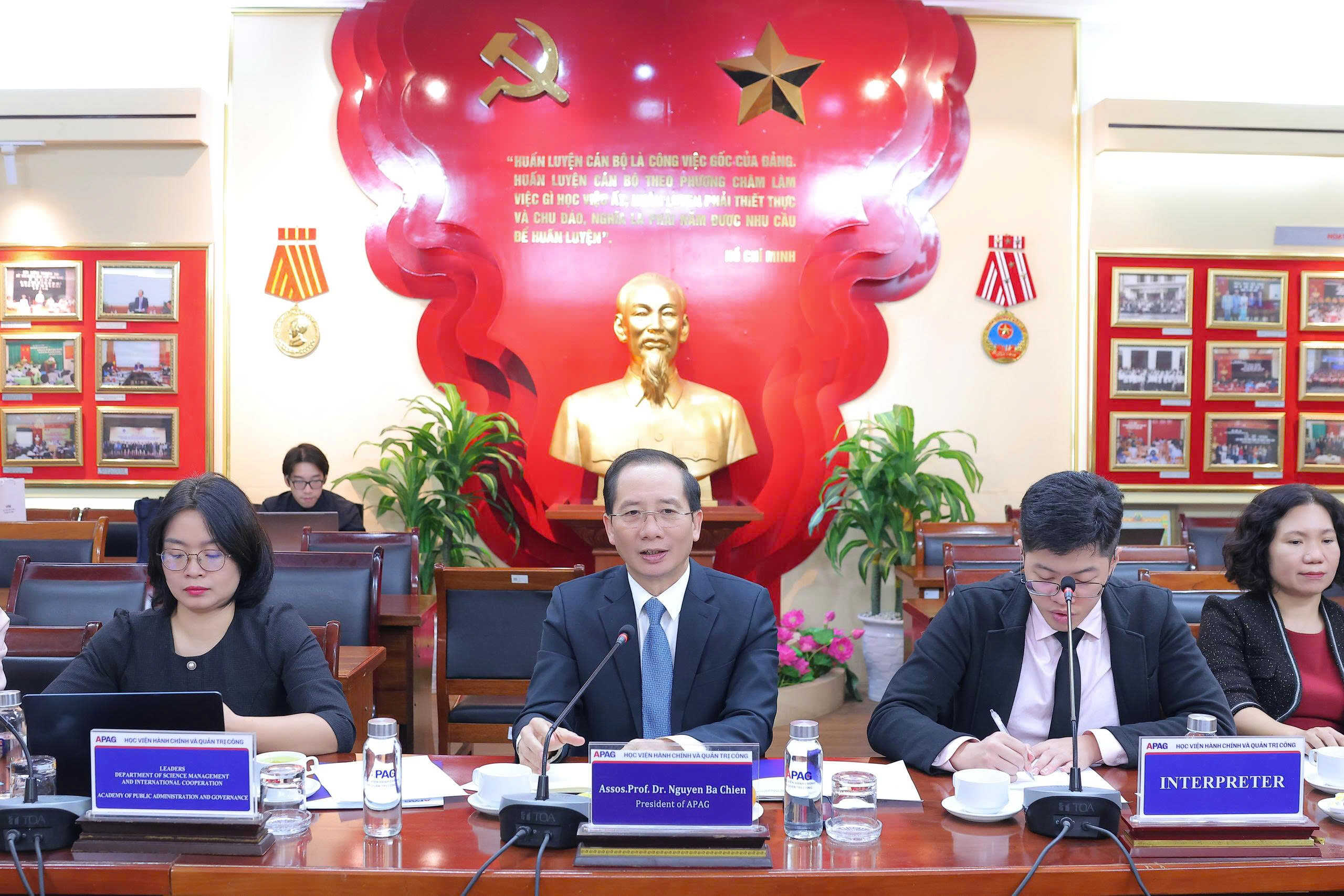 Assoc. Prof. Dr. Nguyen Ba Chien, President of APAG, delivers his remarks at the meeting.
In his welcoming remarks, Assoc. Prof. Dr. Nguyen Ba Chien expressed his pleasure at welcoming the Timor-Leste delegation to work with APAG. He emphasized that international cooperation in public administration and governance provides opportunities for partners to exchange experience, strengthen mutual understanding, and identify collaborative activities aligned with their respective needs and strengths.
Assoc. Prof. Dr. Nguyen Ba Chien noted that APAG places emphasis on translating cooperation into concrete activities that can generate tangible outcomes in training, capacity development, academic research and human resource development. Potential areas of collaboration include developing tailor-made training programmes based on partners' needs, exchanging lecturers and experts, organizing professional workshops, conducting joint research, and sharing teaching materials and practical case studies. Such activities would enable officials and lecturers to gain access to international experience while providing opportunities to share Viet Nam's experience in public governance and administrative reform.
Regarding Viet Nam's two-tier local government system, Assoc. Prof. Dr. Nguyen Ba Chien introduced the organization of local government at the provincial and commune levels, with the district level being abolished. Since 1 July 2025, the new model has been implemented nationwide. The number of provincial-level administrative units was reduced from 63 to 34 provinces and centrally governed cities, while all 696 district-level administrative units were dissolved. The number of commune-level administrative units decreased from 10,035 to 3,321, comprising communes, wards and special zones. This restructuring aims to reduce intermediate administrative layers, clarify the functions and responsibilities of each level, and strengthen the role of grassroots authorities in handling matters for citizens and businesses. Alongside the decentralization of responsibilities, local governments must be equipped with adequate capacities, personnel and resources to fulfil their assigned duties.
Another topic discussed was the establishment of Commune-level Public Administration Service Centres, which combine in-person application reception with online public service delivery through an integrated platform. Organizational restructuring needs to go hand in hand with the improvement of administrative procedures, data connectivity and staff training to ensure uninterrupted public service delivery throughout the transition. Assoc. Prof. Dr. Nguyen Ba Chien also shared several areas requiring further improvement, including strengthening professional capacity at the grassroots level and ensuring that resources are commensurate with the responsibilities delegated to local authorities.
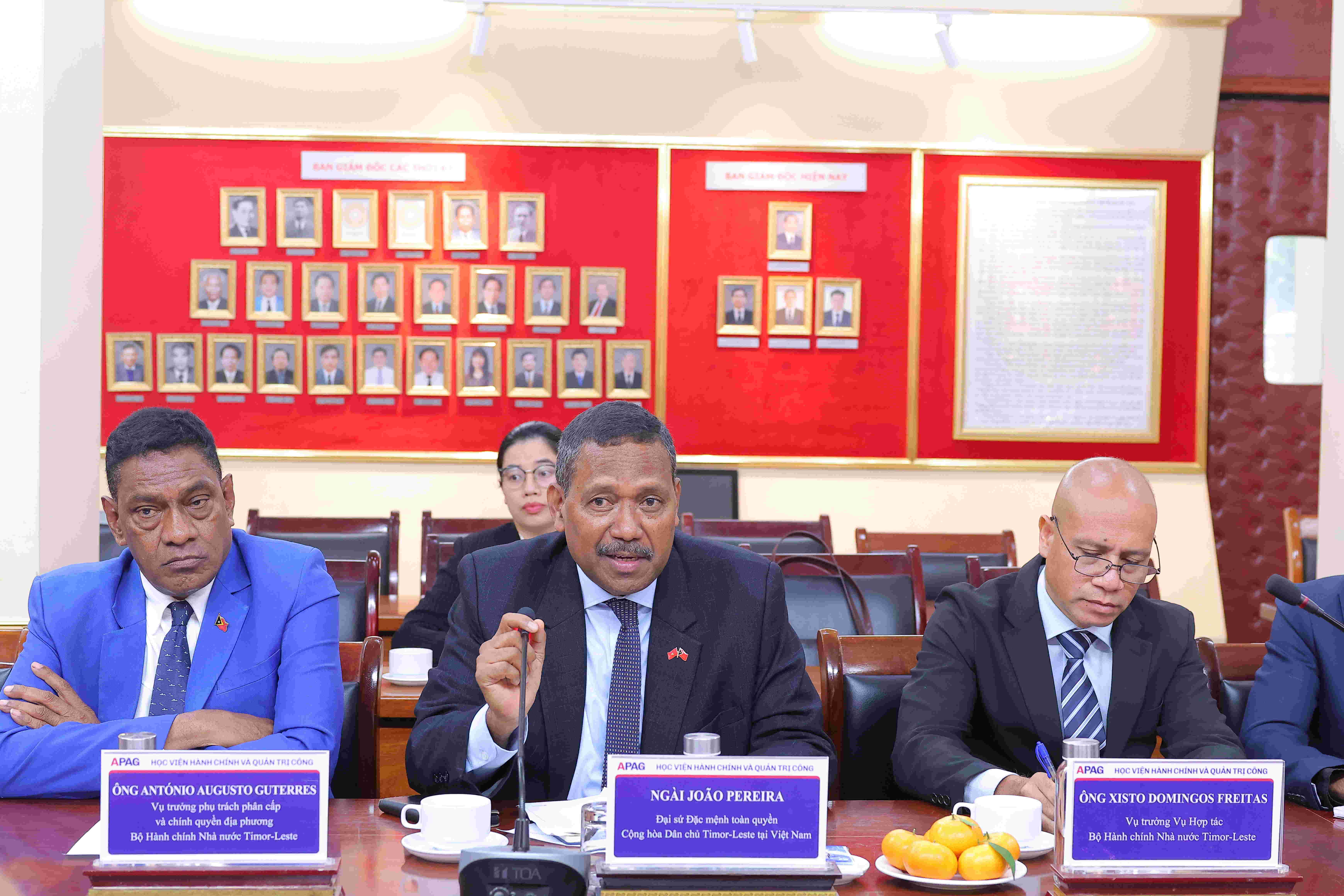 H.E. João Pereira, Ambassador Extraordinary and Plenipotentiary of Timor-Leste to Viet Nam, delivers his remarks.
Ambassador João Pereira thanked APAG for its warm hospitality and described the meeting as a valuable opportunity for the delegation to learn about Viet Nam's administrative reform process, from institutional preparation and organizational restructuring to the delivery of public services at the grassroots level. He expressed particular interest in the discussions on decentralization, the two-tier local government model, digital transformation and civil servant training.
He also noted that experience-sharing between the two countries' public administration agencies and training institutions could broaden professional exchanges, open up new avenues for research, and facilitate the development of capacity-building activities suited to emerging public governance requirements.
He expressed his hope that channels of communication between the two countries' training institutions and specialized agencies would be maintained, with a focus on follow-up activities such as delegation exchanges, sharing of professional materials, and exploring opportunities for cooperation in training and research.
As part of the programme, the delegation attended a presentation on the process, outcomes and lessons learned from administrative reform in Viet Nam. The presentation focused on organizational restructuring and local government reform, digital transformation, competency-based civil servant training aligned with job positions, and approaches to translating ASEAN commitments into programmes and action plans at both national and local levels.
Several potential areas of cooperation were proposed for further consideration by both sides. These included organizing short-term training courses for Timor-Leste officials on decentralization, local government and digital public services; arranging delegation exchanges to learn about the operations of Public Administration Service Centres and agencies responsible for digital government in Viet Nam; conducting comparative research on decentralization and ASEAN integration; and sharing teaching materials and research case studies in English.
These proposals aim to connect training activities, expert exchanges and joint research, based on the needs of both sides and subject to consideration and approval in accordance with applicable regulations.
The meeting contributed to expanding exchanges between APAG and agencies and partners from Timor-Leste, providing a foundation for both sides to further explore practical cooperation in training, capacity development and research in public administration, state management and public governance.
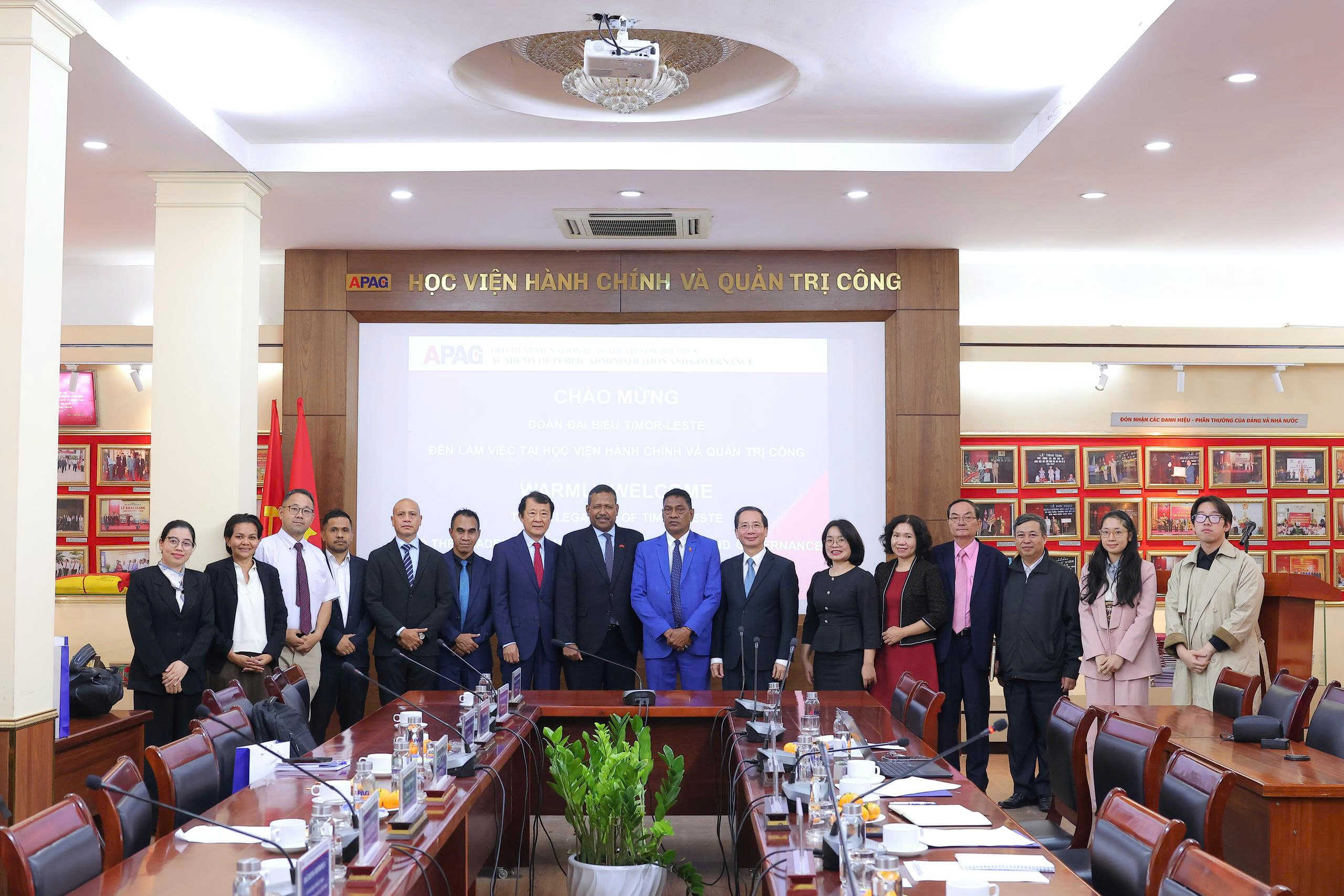 Delegates at the meeting.