On the morning of 5 October 2026, in Ha Noi, the Academy of Public Administration and Governance (APAG), in cooperation with the United Nations Development Programme (UNDP) and the Eastern Regional Organization for Public Administration (EROPA), organized the 2026 Annual International Forum on Public Governance under the theme: “Inclusive Governance in the New Era of Development: System Transformation, Innovations, and Future-Ready Governments.”
APAG English web portal respectfully presents the English translation of the full text of the Framing report delivered by Assoc. Prof. Dr. Nguyen Ba Chien, President of APAG, at the Forum.
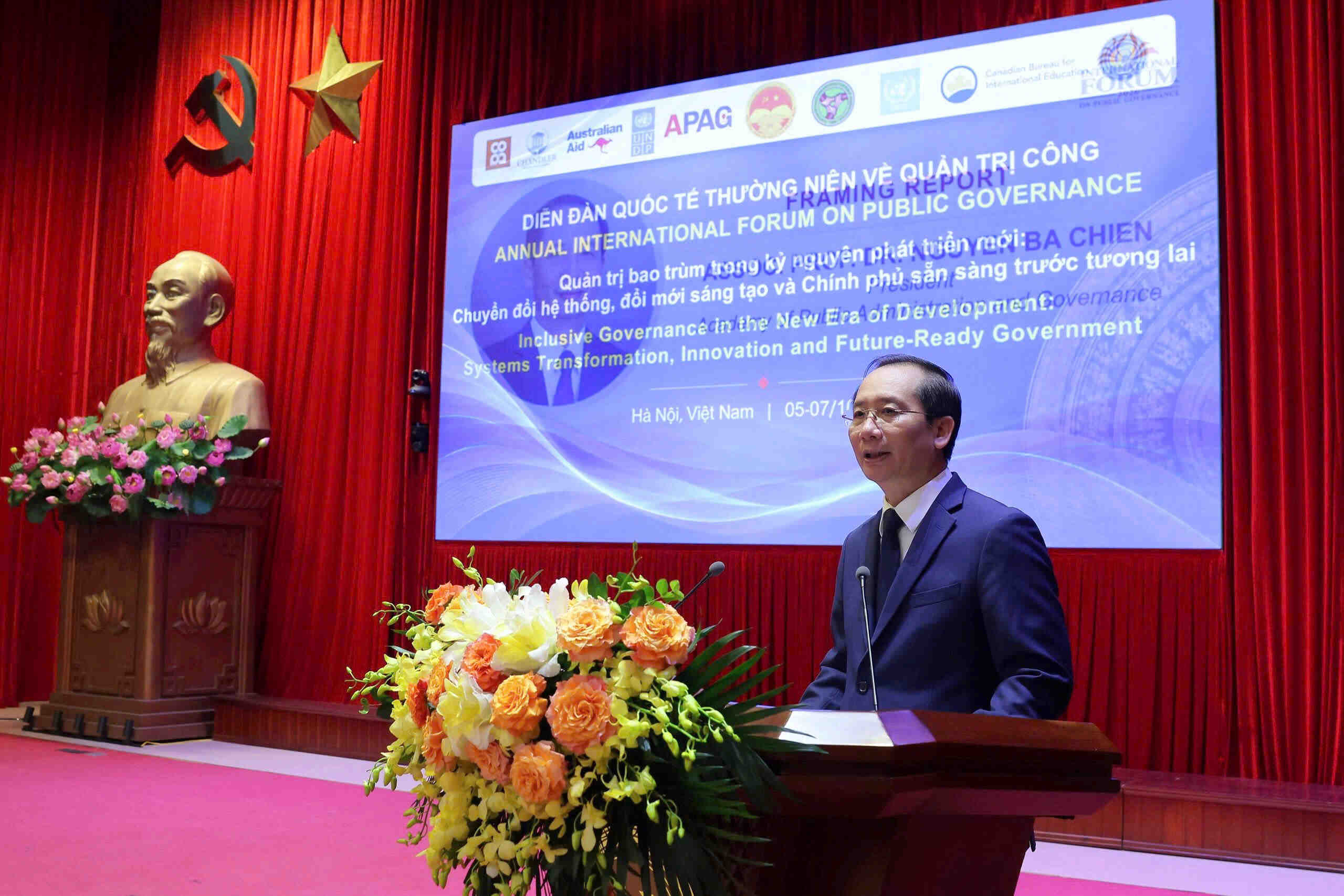 Assoc. Prof. Dr. Nguyen Ba Chien, President of APAG, delivers the Framing report at the Forum.
Distinguished Professor Dr. Nguyen Xuan Thang, Chairman of the Central Council on Theoretical Studies Member of the 13th Politburo,
Distinguished Assoc. Prof. Dr. Nguyen Manh Hung, Vice President of the Ho Chi Minh National Academy of Politics,
Distinguished leaders of central and local Party committees, ministries, agencies and authorities,
Ms. Pauline Tamesis, United Nations Resident Coordinator in Viet Nam,
Ms. Ramla Khalidi, Resident Representative of UNDP in Viet Nam,
Prof. Dr. Alex B. Brillantes Jr., Secretary-General of the Eastern Regional Organization for Public Administration (EROPA),
Excellencies, Ambassadors, representatives of diplomatic missions and international organizations in Viet Nam,
Distinguished delegates,
On behalf of the Academy of Public Administration and Governance and the Forum Organizing Committee, I would like to express my sincere appreciation to Assoc. Prof. Dr. Nguyen Manh Hung, Vice President of the Ho Chi Minh National Academy of Politics, who chaired the Forum and delivered the opening remarks, providing important guidance for the Forum. His remarks placed governance innovation within the broader requirements of national development and highlighted an issue of particular significance at the present stage: reforms must continue to remove constraints and improve the efficiency of the system's operation, while also contributing to the development of new capabilities for the country. The theme of the 2026 Annual International Forum on Public Governance—“Inclusive Governance in the New Era of Development: System Transformation, Innovations, and Future-Ready Government”—was selected in response to precisely these requirements.
Building on these orientations, the Forum is confronted with a major question: in a rapidly changing and increasingly unpredictable world, how should governance systems be prepared to address today's challenges effectively while developing sufficient capacity to respond to the challenges of tomorrow?
System transformation creates new conditions in terms of institutions, organizations, and modes of operation. Innovation opens up new ways of addressing problems. Being future-ready requires the ability to identify changes early, prepare plans and implementation conditions, and adjust approaches to problem-solving. Inclusive governance places people and society at the centre of this process, so that the benefits of development can be accessed and shared more equitably.
From this perspective, I would like to put forward three issues for discussion at the Forum.
First, system transformation must create stronger implementation capacity.
Changes in organizational structures, authorities, procedures, and technology are meaningful only when they enhance the ability to address real-world tasks. For Viet Nam, this is a very concrete issue as the new organizational structure, the two-tier local government system, decentralization and transfer of power, and digital transformation are being put into operation. The key questions are how these changes affect the functioning of the system: whether the authority assigned is accompanied by the necessary conditions for implementation; whether responsibilities are sufficiently clear; whether coordination among agencies and levels of government is truly seamless; whether emerging issues are addressed in a timely manner; and how the quality of services provided to citizens and businesses is substantively changing.
The local level is where these issues are directly tested. Localities are where policies are translated into practice and where many development issues need to be addressed. At the same time, an increasing number of issues extend beyond the scope of a single sector or level of government, requiring the capacity to coordinate, mobilize resources, manage intersectoral and intergovernmental relationships, and pursue integrated governance. Therefore, system transformation needs to be tested through the capacity to act and through real-world problem-solving results. Implementation capacity and local governance are central themes of this year's Forum.
Second, governance capacity today is first and foremost the capacity to solve problems amid constant change.
Many public issues are becoming increasingly complex, extending beyond the scope of a single sector or level of government and potentially changing even as they are being addressed. New issues are also continuously emerging under the impact of technology, climate change, changing economic and employment models, and new risks. This requires the ability to correctly identify problems, detect early changes that may affect development, use data and evidence, coordinate action, and make timely adjustments as conditions change. This is also an important dimension of a future-ready government. Many decisions concerning institutions, infrastructure, human resources, and technology require a long time to produce their full effects. Early identification gives the State more time to prepare, assess options, and make policy choices more proactively.
Innovation, data, and artificial intelligence expand the capacity to identify problems, support decision-making, organize implementation, and monitor results. Alongside these opportunities come requirements for data quality, the capacity to use such tools, accountability, and risk control.
A capable governance system must also be able to learn from its own practice. Information from implementation should be used to test policies, identify emerging issues, and adjust approaches. The ability to learn and continuously adapt enables the system to respond more effectively to changes that cannot be fully anticipated in advance.
Third, outcomes and public value must become important measures of development governance capacity.
Compliance with the law and adherence to proper authority and procedures are fundamental requirements of public governance. The quality of development governance must also be demonstrated through tangible outcomes: the extent to which problems are resolved; how the quality of services provided to citizens and businesses is improved; whether social costs are reduced; and whether access to services and development opportunities is expanded to all citizens and businesses.
The public value approach helps assess outcomes beyond the scope of individual agencies' activities. What matters is the impact that policies create for citizens, businesses, and society, including the degree of fairness in access to and enjoyment of development outcomes. This also provides a basis for assessing decentralization and delegation of authority, digital transformation, innovation, and the application of artificial intelligence. Decentralization and delegation of authority should enhance the ability to address tasks at the level to which authority has been assigned. Digital transformation should reduce time and costs while increasing convenience and transparency. Technology and artificial intelligence should contribute to improving the quality of public decision-making, implementation, and services. Ultimately, results must be reflected in the problems that are resolved and the tangible value received by citizens, businesses, and society.
Distinguished leaders,
Distinguished delegates,
The three issues above all point to one requirement: transformation in institutions, organizations, and technology must enhance implementation capacity and generate development outcomes. The Forum should clarify the conditions that determine implementation effectiveness; the relationship between decentralization and delegation of authority; capacity and responsibility; the role of data and technology in decision-making; and the ability to learn from practice and adjust policies accordingly.
International experience is highly relevant to these issues. When studying a successful model, what matters is understanding the conditions that produced the results: institutions, implementation capacity, resources, coordination mechanisms, and processes of adjustment. A clear understanding of these conditions will enable international experience to be referenced and applied more appropriately to the Vietnamese context.
Distinguished leaders,
Distinguished delegates,
This year's Forum brings together nearly 300 international delegates and more than 300 Vietnamese delegates, with nearly 150 papers and more than 100 presentations delivered by domestic and international speakers across 20 panels; approximately 40 leaders, policymakers, experts, and scholars are directly participating in plenary sessions, policy dialogues, and roundtable discussions. This scale and broad participation demonstrate that the issues raised by the Forum's theme are receiving significant attention from policymakers, public managers, and the academic community both in Viet Nam and internationally. The Academy of Public Administration and Governance sincerely appreciates the attention and support of the Ho Chi Minh National Academy of Politics; the cooperation of EROPA, UNDP, United Nations organizations, and domestic and international partners; and, in particular, the presence and professional contributions of all distinguished delegates.
For the Academy of Public Administration and Governance, Viet Nam's practice of innovating development governance raises many issues that require systematic research and review. As an institution under the Ho Chi Minh National Academy of Politics, APAG is well positioned to link theoretical research on public administration, public governance, and development governance with the review of practice and policy advice at the national level. APAG seeks to progressively contribute valuable research findings on development governance to support education and training, capacity building, policy advice, and the development governance of the country and its localities.
The Forum should therefore be followed by joint research, concrete cooperation programmes, and valuable collaborative outputs. APAG looks forward to working with EROPA, United Nations organizations, academies, universities, research institutions, and other partners to continue studying issues of common interest, sharing experience, and bringing research findings into practice; while also creating more opportunities for experience and research findings from Viet Nam to be exchanged and shared more widely across the region and internationally.
On behalf of the Academy of Public Administration and Governance, I would like to express my sincere appreciation to the distinguished leaders, Ambassadors, representatives of diplomatic missions and international organizations, experts, scholars, and all delegates for attending and contributing to the Forum.
I wish all distinguished leaders, experts, international delegates, and all of you good health, and I wish the Forum every success.
Thank you very much!