On the morning of 5 October 2026, in Ha Noi, the Academy of Public Administration and Governance (APAG), in cooperation with the United Nations Development Programme (UNDP) and the Eastern Regional Organization for Public Administration (EROPA), organized the 2026 Annual International Forum on Public Governance under the theme: “Inclusive Governance in the New Era of Development: System Transformation, Innovations, and Future-Ready Governments.”
APAG English web portal respectfully presents the English translation of the full text of the opening remarks delivered by Assoc. Prof. Dr. Nguyen Manh Hung, Vice President of the Ho Chi Minh National Academy of Politics (HCMA) and Vice Chairman of the Central Council on Theoretical Studies, at the Forum.
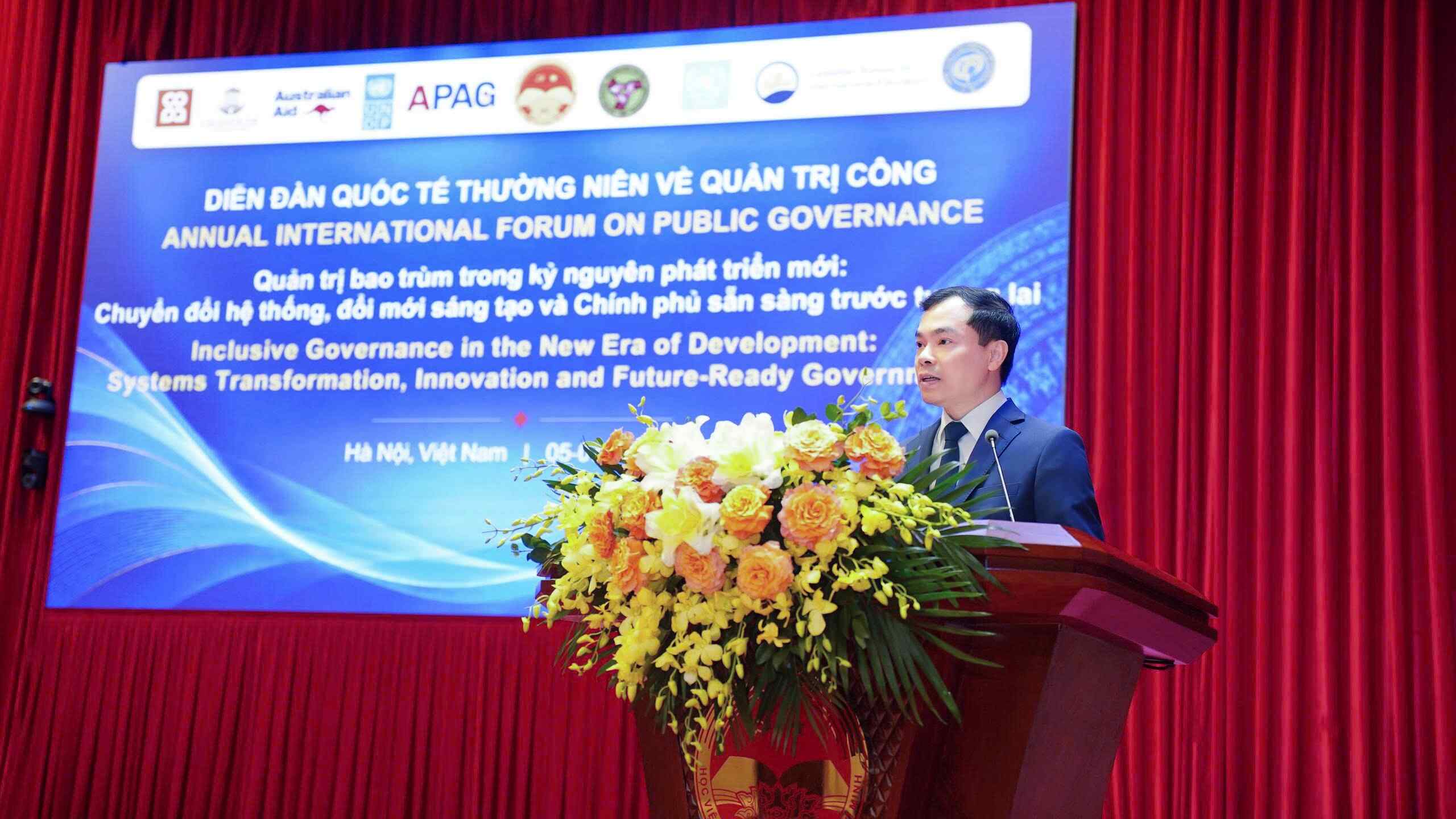 Assoc. Prof. Dr. Nguyen Manh Hung, Vice President of the Ho Chi Minh National Academy of Politics (HCMA) and Vice Chairman of the Central Council on Theoretical Studies, delivers opening remarks at the Forum.
Distinguished leaders,
Excellencies, Ambassadors and representatives of international organizations,
Distinguished delegates, experts and scholars,
On behalf of the Ho Chi Minh National Academy of Politics, I am delighted to warmly welcome you to the 2026 Annual International Forum on Public Governance, under the theme “Inclusive Governance in the New Era of Development: System Transformation, Innovation, and Future-Ready Government.”
This Forum takes place as Viet Nam enters a new development era after 40 years of comprehensive Doi Moi, or Renewal. With the aspiration of becoming a developed, high-income country by 2045, Viet Nam is increasingly aware of the critical importance of national governance. Great aspirations must be underpinned by commensurate governance capacity so that our vision can be translated into feasible policies and coherent action, and so that people can experience tangible improvements in their everyday lives.
Distinguished guests,
The theme of the Forum suggests a coherent and interconnected approach built around three elements: system transformation to establish new foundations; innovation to generate breakthroughs in development; and building the proactive, adaptive, and self-renewing capacity of government to be ready for the future. These are essential steps towards inclusive governance that is people-centred and built together with the people.
Viet Nam is undertaking reforms of its institutional and organizational structures, operating a two-tier local government system, promoting decentralization and delegation of authority, and accelerating digital transformation. These are not merely organizational changes, but a process of systemic transformation that requires coordinated innovation—from identifying problems and designing policies to coordinating action and implementing policies. At the same time, it calls for stronger linkages among the State, the market, and society, with shared responsibilities and a common commitment to the country's development goals.
These transformations lay the foundation for a governance ecosystem that not only responds to present needs but also proactively adapts to the future. The capacity of a government is demonstrated not only by how well it addresses today's challenges, but also by its ability to identify changes early, prepare for emerging challenges, and seize tomorrow's opportunities. A future-ready government is not one that knows everything in advance, but one that looks ahead, prepares early, adapts quickly, and continuously renews itself. It is a government that does not merely respond to what is coming, but proactively creates new possibilities for development and works together with its people to shape a better future.
To achieve this, we need to strengthen foresight in governance—proactively identifying changes and preparing early and well in advance. We must learn to listen for “weak signals”—subtle signs that may foreshadow major shifts; regularly revisit familiar assumptions; develop multiple scenarios; and stress-test policies against different circumstances. We must remain steadfast in our long-term goals while remaining flexible in our courses of action. We should not place the country's future on a single scenario, however plausible that scenario may appear.
This proactive mindset also means preparing for “black swans”—events that fall outside conventional expectations yet can have profound impacts. We cannot anticipate every disruption, but we can reduce vulnerabilities, build contingency resources, and ensure the continuity of essential services when shocks occur. A change that has already been anticipated should not become a “surprise” simply because we were slow to prepare and slow to act.
Most importantly, we must translate foresight into the capacity to act. Every scenario should be linked to concrete response options, with clear responsibilities, authorities, resources, and indicators showing when policy adjustments are needed. To do this, we need to connect the analytical capacity of public institutions with the knowledge and experience of academia, businesses, and communities. We should also regularly exercise scenarios, assess levels of preparedness, and update policies accordingly. Foresight must become an essential part of decision-making and governance, rather than remaining confined to reports.
Distinguished guests,
Innovation opens up new tools for these systemic changes. AI can help identify risks, analyze scenarios, and provide services tailored to individual citizens. Yet technology does not automatically produce good governance. The use of AI must go hand in hand with data protection, privacy safeguards, bias control, and accountability. Technology should support decision-making, not replace the responsibility of decision-makers.
The more we innovate, the more firmly we must uphold the goal of inclusiveness. Citizens should not merely be users of public services; they should be actively involved in policy formulation, implementation, and oversight. A future-ready government must also help its people become future-ready, through education, reskilling, and adaptive social protection.
The responsibility for building inclusive governance does not stop at national borders. It also extends to addressing challenges that affect the survival and future of humanity. Climate change requires coordinated efforts in emissions reduction, adaptation, and livelihood protection. AI calls for cooperation on safety, ethics, and the equitable sharing of benefits. Population ageing requires long-term preparation in healthcare, social protection, employment, and lifelong learning. These challenges require the collective capacity of governments to act together.
Within global governance mechanisms, developed countries need to play a leading role in providing climate finance, sharing technology, and strengthening governance capacity, thereby contributing to narrowing development gaps. Developing countries, for their part, need to proactively pursue institutional innovation and strengthen their domestic capabilities—not merely to receive solutions, but also to participate in shaping common principles and initiatives.
In the Asia–Pacific and Indian Ocean region, which brings together both developed and developing countries, economies need to share experiences in fostering development, digital transformation, and adaptation to population ageing; strengthen technological cooperation; and coordinate responses to risks. Differences in levels of development do not diminish our shared responsibility: to protect people, sustain dialogue, and jointly shape a safe and sustainable future.
I hope our Forum will focus on addressing several key questions: How can foresight and scenario planning be integrated into the regular operations of government? What mechanisms can enable the entire system to learn and innovate while maintaining discipline and responsibility? How can the adaptive capacity of individual countries contribute to strengthening the world's collective ability to respond to challenges? Viet Nam looks forward to learning from others, sharing our own experiences, and working with partners to build networks of cooperation in strategic foresight, governance innovation, and inclusive development. We cannot choose every disruption that the future may bring, but we can choose how we prepare and how we act together.
I would like to express my sincere appreciation to the Academy of Public Administration and Governance, the United Nations Resident Coordinator Office in Viet Nam, the United Nations Development Programme, the United Nations Project Office on Governance, the Eastern Regional Organization for Public Administration, and all our partners for their valuable support in organizing this Forum. I am confident that the Forum will contribute to transforming our shared vision into practical capacity, enabling governments not only to be ready for the future, but also to work together with their people to build a better future.
With that spirit, I hereby declare the opening of the 2026 Annual International Forum on Public Governance.
I wish you all good health and every success.
I wish the Forum every success!
Thank you very much.