INSTITUTIONAL TRANSFORMATION: VIETNAM’S VISION FOR A NEW ERA OF DEVELOPMENT
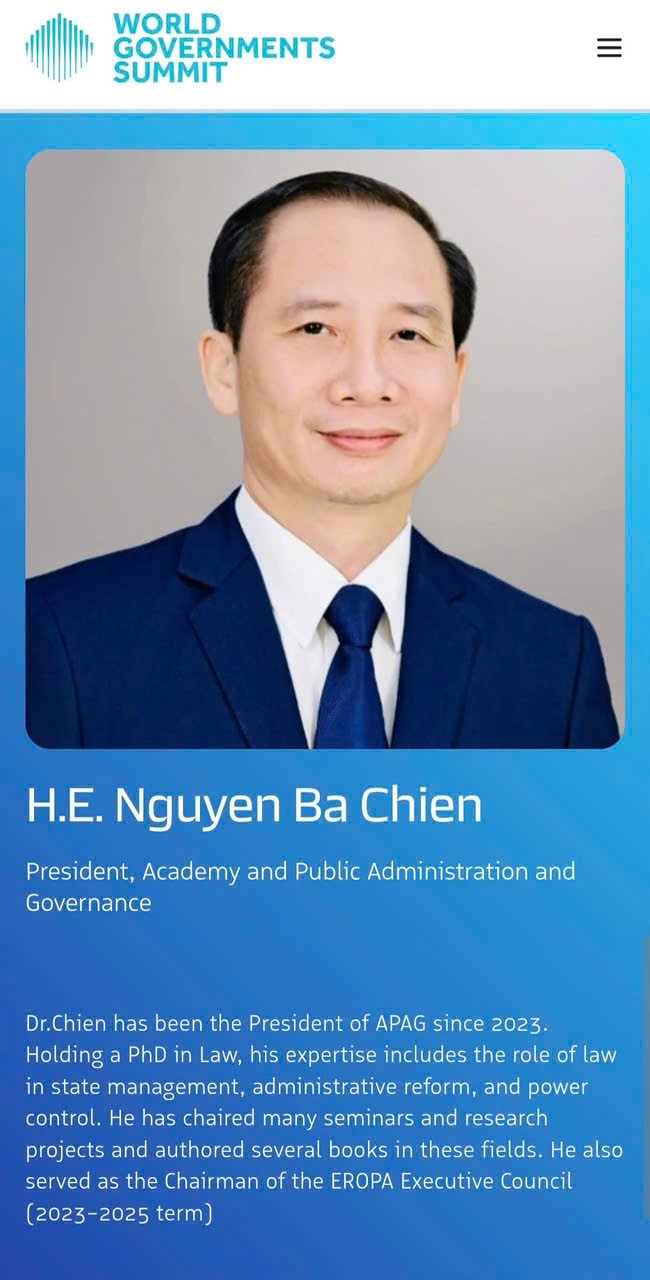
Address by Assoc. Prof. Dr. Nguyen Ba Chien,
President, Academy of Public Administration and Governance, Vietnam at the World Governments Summit 2026, Dubai, UAE “Shaping Future Governments”
 Assoc. Prof. Dr. Nguyen Ba Chien, President of the APAG, at the High-Level Roundtable Seminar: Shaping Global Government
Distinguished Chair,
Excellencies, Distinguished Delegates, Ladies and Gentlemen,
We are living in a world marked by rapid, profound, and increasingly unpredictable change - from strategic competition among major powers and disruptions in global supply chains, to shifting growth models and emerging non-traditional security challenges.
In this context, the central question of governance today is no longer simply how to grow faster, but more fundamentally how to govern for sustainable, inclusive, and resilient development.
From Vietnam’s experience, I would like to share one core conviction: institutional reform is not a technical adjustment; it is a strategic choice about a nation’s future. It is the key that unlocks a new era of development.
1. A Historical Crossroads: When Reform Becomes a Development Imperative
Vietnam enters 2026 with impressive figures: GDP reaching USD 514 billion, and per capita income exceeding USD 5,000. Vietnam is now among the world’s 32 largest economies and has joined the group of upper-middle-income countries.
Yet this success also brings us to a structural crossroads. Either Vietnam makes a decisive breakthrough toward becoming a developed country, or it risks stagnation in the middle-income trap as traditional growth drivers- cheap labor, resource extraction, and capital accumulation - reach their limits.
Our demographic dividend will last only about one more decade, while global uncertainties are accelerating and systemic shocks are becoming harder to predict.
Vietnam, however, possesses a form of invisible strategic capital: political stability, strong social consensus, and the trust of more than 100 million citizens in the reform path. This social capital enables us to mobilize collective strength and undertake difficult and sensitive reforms - particularly those that directly impact vested interests, organizational structures, personnel, and long-standing administrative habits.
It is in this context that the 14th National Congress of the Communist Party of Vietnam, in January 2026, was identified as the starting point of a new national resurgence. Vietnam has chosen to transform its growth model and aims for double-digit growth (over 10%) from 2026 onward, with a clear understanding: such ambition is impossible without a fundamental breakthrough in institutions, governance mindset, and implementation capacity.
2. Institutional Reform: The Foundation for Transformation
Vietnam’s vision for institutional reform is articulated in the documents of the 14th Party Congress and operationalized through nine strategic resolutions that shape a new institutional architecture.
For us, reform is not incremental adjustment; it is a transformation in thinking. We are building a comprehensive development strategy in which politics is the foundation, the economy is the driving force, and development serves stability and people’s well-being.
Our guiding philosophy can be summarized as: A developmental state - A market-led economy - A supportive society - with people at the center.
On this basis, Vietnam is advancing national governance reform along six strategic directions:
First, institutions that foster innovation: science, technology, and digital transformation as core drivers, with advanced legal frameworks to strengthen autonomy in the knowledge economy.
Second, institutionalizing a new growth model: unleashing new productive forces based on the data economy, digital economy, and green transition; prioritizing regulations that enhance productivity, quality, and national competitiveness.
Third, transforming legal thinking from “control” to “enablement”: fundamentally changing law enforcement culture; using citizen and business satisfaction as key performance indicators, and treating institutional quality as a core competitive advantage.
Fourth, strengthening institutions for energy security and green transition: legal frameworks for sustainable development, and recognizing global green standards as essential conditions for economic survival.
Fifth, linking institutional reform with deep international integration and strategic autonomy: proactive and responsible global integration while strengthening internal capabilities and safeguarding national interests.
Sixth, building a modern and inclusive social welfare system: viewing investment in education, healthcare, culture, and social protection as investment in the future the foundation of sustainable and inclusive development where no one is left behind. Commitments such as free public education, regular free health checkups, and gradual elimination of basic hospital fees affirm a clear principle: all development goals exist for people’s happiness, and all reform outcomes must serve humanity.
Together, these pillars form a new institutional architecture: a developmental state; a dynamic and creative market; a collaborative and supervisory society; and a unified, collective citizenry. This is the firm lever for Vietnam to become a modern industrial developing country by 2030, and a high-income developed country by 2045.
3. Institutional Reform and the Organizational Revolution: From Streamlining to Action Capacity
Alongside these institutional shifts, since late 2024, and especially throughout 2025, Vietnam has implemented sweeping administrative restructuring across the entire political system, guided by one principle: lean, efficient, effective, and impactful -across the entire political system.
At the central level, the Government reduced the number of ministries from 22 to 17 (a 22.7% reduction), while streamlining internal structures.
At the local level, Vietnam moved from a three-tier system to a two-tier system, reducing provinces from 63 to 34 (a 46% reduction) and abolishing all 696 district-level administrations. Commune-level units decreased from 10,035 to 3,321 (a 66.9% reduction). In 2025 alone, nealy 147,000 positions in the public sector were eliminated, generating substantial fiscal savings approximately USD 7 billion for the state budget over 2026 - 2030 while strengthening decentralization, accountability, and power control mechanisms.
The objective of these reforms is not merely cost reduction, but faster decision-making, closer government -citizen relations, improved public services, and the reallocation of resources toward development and social welfare.
As a result, regulatory processes have accelerated, long-standing bottlenecks in investment and infrastructure have been addressed, and Vietnam achieved economic growth exceeding 8% in 2025 - among the highest in the world.
More importantly, these reforms are reshaping Vietnam’s governance culture - from “management and control” to “enablement and service.” Institutional reform is directly translating into governing capacity, social trust and new development space.
4. Vision 2045: A Message to the World
From a public governance perspective, we believe that institutional reform is the most critical strategic lever for Vietnam to escape the middle-income trap and unlock new development horizons.
By 2045, Vietnam aspires to be a developed, prosperous, civilized, and happy nation-where economic growth goes hand in hand with social progress and environmental protection; where the state operates on the foundations of rule of law, integrity, development orientation, and accountability; and where people are truly at the center of all policies, with their happiness both the goal and the driving force of development.
From Vietnam’s reform experience, we offer three reflections for future governments:
First, future governments are not those with greater power, but those with greater capacity for action - the capacity to make timely decisions, grounded in data, informed by dialogue, and closely linked to accountability.
Second, streamlining the state does not mean reducing the role of government; it means enhancing the quality of state intervention - focusing on the areas where the state performs best and where society needs it most, rather than being overstretched, fragmented, and inefficient.
Third, sustainable development cannot be separated from social equity and human happiness. Growth is truly meaningful only when all citizens share its benefits, have access to quality public services, and are given real opportunities to thrive.
From these lessons, we argue that future governments cannot be built on technology alone. They must rest on three fundamental pillars: the rule of law, public service ethics, and social trust. Technology may make a Government faster, but the rule of law and the people's trust are what make a Government sustainable.
Distinguished delegates,
Vietnam has chosen a difficult but necessary reform path. We reform not because of external pressure, but because of internal aspiration; not to be different, but to be better, more effective, and more humane.
In a turbulent world, we believe Vietnam’s institutional reform experience - grounded in political stability, social consensus, and strong reform commitment - can contribute a meaningful and practical perspective to the global dialogue on Shaping Future Governments.
With this spirit, Vietnam stands ready to be a reliable and responsible partner - sharing experiences, learning together, and co-creating better governance models for a future of sustainable development, peace, and shared prosperity.
Thank you very much for your attention.